
Global HIV Programme
The WHO Department of Global HIV, Hepatitis and
Sexually Transmitted Infections Programmes leads the development and
implementation of the global health sector strategy on the elimination
of HIV as a public health threat.
HIV data and statistics
Global data
People living with HIV
- An estimated 39.9 million [36.1–44.6 million] people were living with HIV at the end of 2023, of which
- 1.4 million [1.1–1.7 million] children (0–14 years old).
- 38.6 [34.9–43.1 million] adults (15+ years old).
HIV incidence
- 1.3
million [1.0–1.7 million] people acquired HIV in 2023. Since 2010, the
number of people acquiring HIV has been reduced by 39%, from 2.1 million
[1.7–2.7 million].
- 120 000 [83 000–170 000] children acquired HIV in 2023.
- 1.2 million [950 000–1.5 million] adults acquired HIV in 2023.
- The number of people acquiring HIV decreased to 0.17 [0.13–0.21] per 1000 uninfected population in 2023 from 0.32 [0.25–0.40] in 2010.
- Since the start of the epidemic, 88.4 million [71.3 million–112.8 million] people have acquired HIV.
HIV-related mortality
- In
2023, 630 000 [500 000–820 000] people died from
HIV-related causes globally. Since 2010, HIV-related deaths have been
reduced by 51%, from 1.3 million [1.0 million–1.7 million]. The global
HIV epidemic claimed 69% fewer lives in 2023 since the peak in 2004.
- 76 000 [53 000–110 000] children died from HIV-related causes in 2023.
- 560 000 [430 000–730 000] adults died from HIV-related causes in 2023.
- HIV continues to be a major global public health issue, claiming 42.3 million [35.7–51.1 million] lives so far.
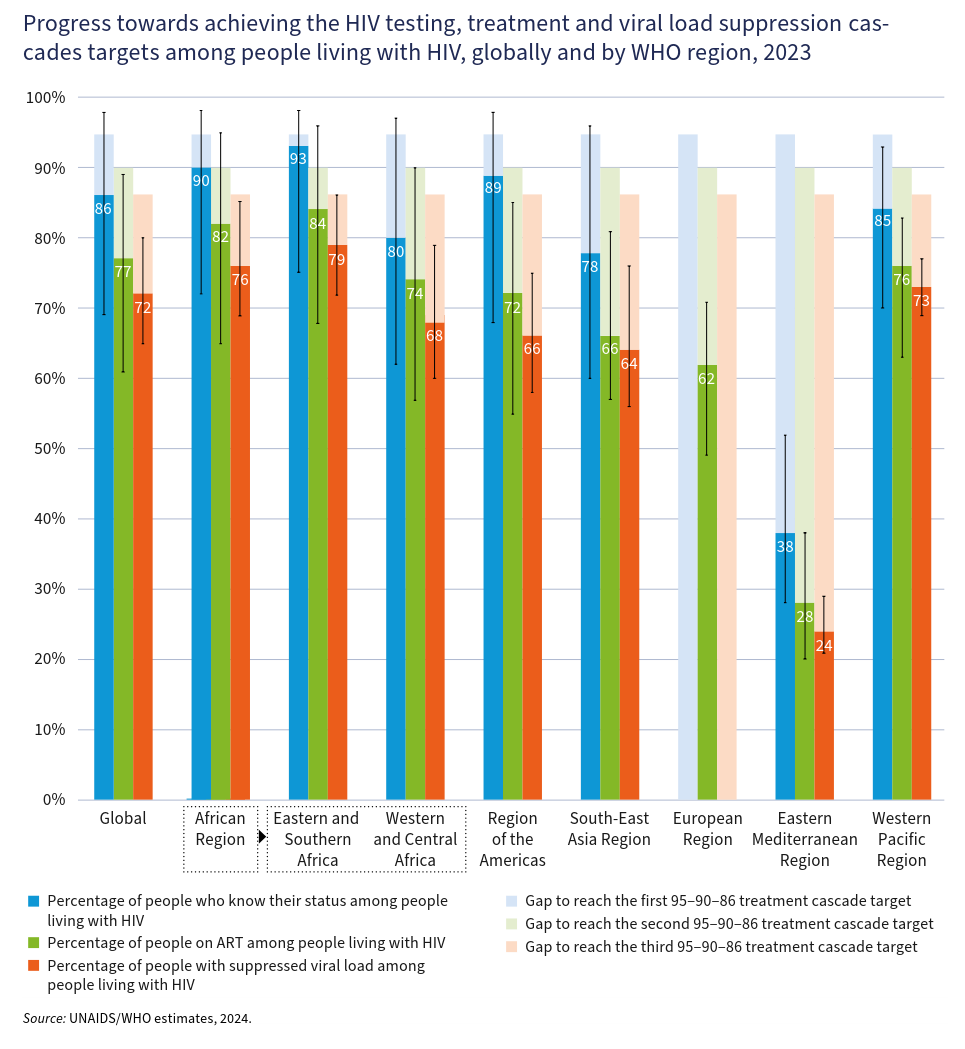
Testing, treatment and viral load suppression cascades among all people living with HIV
By 2025, 95% of people living with HIV should know their HIV status (first 95)
- In 2023, 86% [69–>98%] of people living with HIV knew their status.
- To reach the first 95–95–95 target, an additional 3.4 million people living with HIV need to be made aware of their HIV status.
People living with HIV receiving antiretroviral therapy (second 90)
- In 2023, 77% [61–89%] of people living with HIV were receiving antiretroviral therapy.
- To reach the second 95–90–86 testing, treatment and viral load suppression cascade target, an additional 5.4 million people living with HIV need to know their status and access antiretroviral therapy.
People living with HIV with suppressed viral loads (third 86)
- In 2023, 72% [65–80%] of people living with HIV had suppressed viral loads.
- To reach the third 95–90–86 testing, treatment and viral load suppression cascade target, an additional 5.6 million people living with HIV need to know their status, access antiretroviral therapy, and have viral load suppression.
Source: UNAIDS/WHO estimates, 2024.
 | HIV statistics, globally and by WHO region, 2024 |
Summary
/global-hiv-hepatitis-and-stis-programmes-(hhs)/summary-hiv-epidemic-2023.png?sfvrsn=932966b5_2 "summary-of-the-global-HIV-epidemic-2021")
Global trends
/global-hiv-hepatitis-and-stis-programmes-(hhs)/hiv-trends-2023.png?sfvrsn=dea56a67_1 "global-trends-in-poeple-acquiring-hiv-and-people-dying-from-HIV-a")
Progress towards HIV testing, treatment and viral load suppression cascades targets
HIV policy uptake

Fact sheet: HIV policy adoption and implementation status in countries(July 2024 – PDF, 13.3 MB)

More data
Global epidemic
Prevention of mother-to-child transmission
Pediatric antiretroviral therapy coverage
Testing and counselling
Antiretroviral therapy